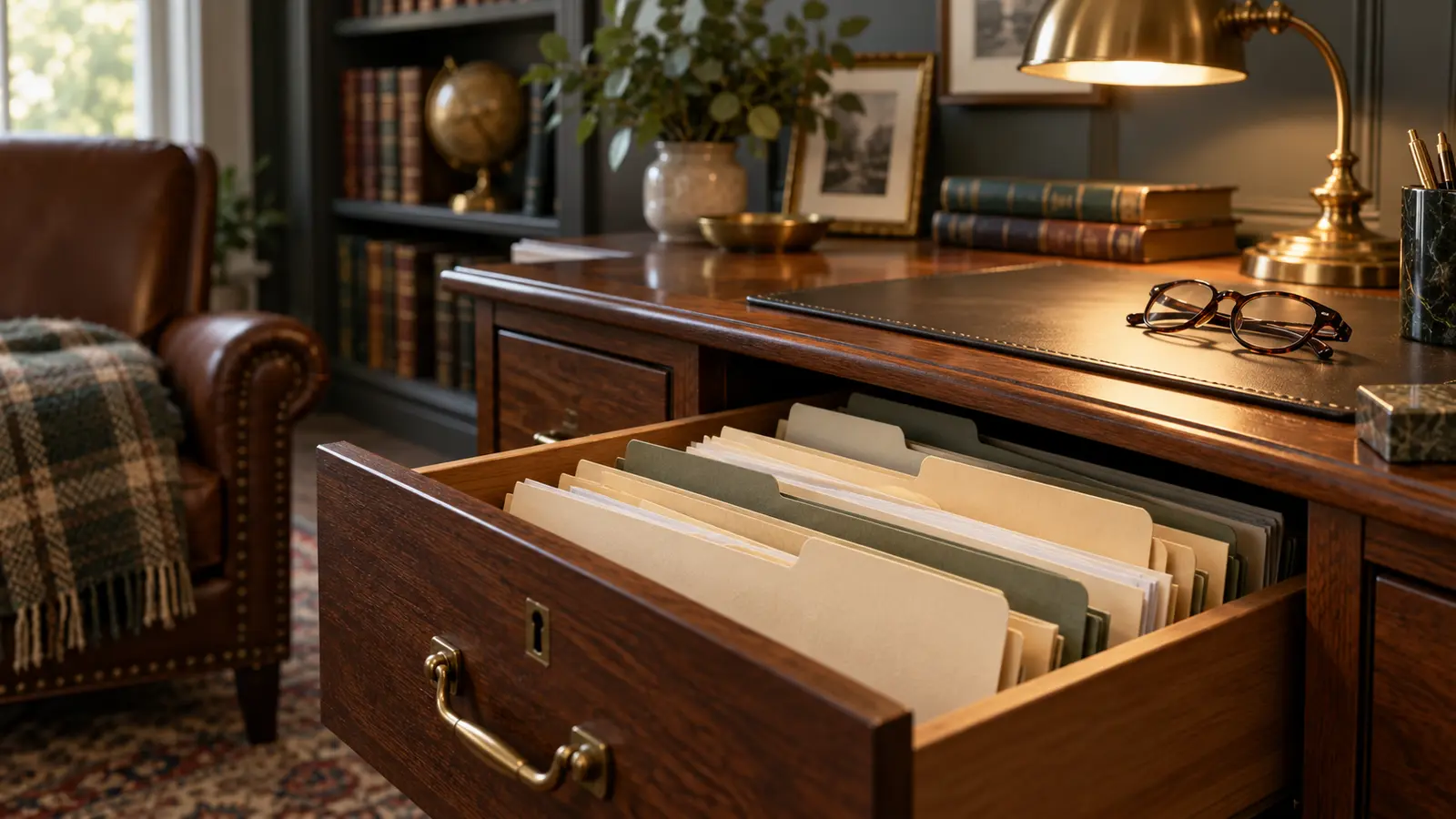
The useful document search is not a hunt for one magic folder. You are trying to answer three different questions: what did the person direct, what did they own, and what obligations or beneficiary arrangements change how those assets transfer.
Start with the original will and trust documents, but keep searching after you find them. A beneficiary designation on an IRA or life-insurance policy can control an asset even when the will says something different, and a deed can show survivorship rights that keep a home out of probate.
Search the places where originals are likely to live
Check a home safe, fire box, locked desk, filing cabinet, safe-deposit records, and any binder labeled estate, legal, trust, taxes, or insurance. Look for the lawyer who drafted earlier documents: invoices, email correspondence, or the attorney's name printed on an old will can provide a lead. Ask close family members whether the decedent ever said where the original was stored.
Some jurisdictions provide a mechanism for depositing or lodging a will with a court, while others generally see the original only after death when probate is filed. Do not assume a county courthouse has a copy simply because the person lived there. Search the court's own probate self-help instructions for the county and state involved.
If you find multiple wills, preserve all of them. Do not throw away an older signed version because a newer-looking document exists. Dates, revocation language, execution formalities, and later codicils may need legal review.
Treat the signed original as evidence, not office paper
Many probate courts expect the original will when a probate petition is filed. A photocopy may create an additional proof problem because the court can need an explanation for why the original is missing and whether it was revoked. The exact procedure is state law, so do not write on, unstaple, laminate, or alter the original.
Place the document in a sleeve, scan it for working use, and store the original separately. If a named executor needs to show family members what it says, distribute scans rather than passing the original around a kitchen table. If a lawyer or court asks to receive it, make a record of when and how it was delivered.
A will nominates an executor but does not itself always give immediate transaction authority. Banks and title agencies commonly wait for court-issued Letters after the probate court appoints the personal representative.
Build four folders: ownership, beneficiaries, liabilities, and identity
The last one or two years of account statements are more useful initially than twenty years of records. They reveal current institutions, automatic payments, direct deposits, and tax-reporting forms. Keep older records until you know there is no unresolved basis, business, property, or tax issue that requires them.
- Ownership folder: deeds, vehicle titles, bank and brokerage statements, business records, and other evidence of how property was titled.
- Beneficiary folder: life-insurance records, retirement beneficiary paperwork, POD/TOD notices, trust schedules, and claim correspondence for assets that may pass outside probate.
- Liability folder: mortgage statements, cards, tax bills, medical bills, contracts, and other records that may become estate claims or secured obligations.
- Identity and tax folder: certified death records, Social Security information, prior tax returns, marriage or divorce records, and documents that establish the decedent’s legal identity or filing history.
Use the tax return as an asset-finding map
A prior federal return can point to banks that issued interest, brokerages that reported dividends or sales, retirement distributions, rental property, partnerships, businesses, and mortgage interest. Match each tax form to a current statement or contact. An entry on last year's return does not prove the asset still exists, but it is a strong lead.
Search email carefully for annual statements, insurance renewal notices, cloud storage, and messages from financial advisers. Preserve access rather than deleting the account. Digital-access law and provider terms can limit what a fiduciary may obtain, so use formal legacy-contact or fiduciary processes where available rather than guessing passwords or impersonating the decedent.
Mail arriving over the next several weeks is another discovery tool. Keep it in one place and scan the sender names into the asset-and-liability list.
When the will cannot be found, stop short of inventing one
If relatives remember a will but no signed original can be found, make a chronology of the search: locations checked, people contacted, lawyer names, and any copies located. A copy can still matter, but whether it can be admitted and what proof is required depends on state law. This is a good point for a probate lawyer if a missing original changes who would inherit.
If no will existed, the estate is not ownerless. State intestacy law supplies the inheritance rules, and the court can appoint an administrator. The document hunt still matters because deeds, beneficiary designations, joint accounts, and trust assets may transfer outside the intestate probate estate.
When you find several versions of a will, codicil, trust amendment, or unsigned draft, keep all of them and record where each was found. Do not staple pages together, remove staples, write on originals, or discard an older document merely because a newer-looking copy exists. The probate court or estate lawyer may need the original document history to determine which instrument controls. A simple photo of the storage location plus an envelope for each original is safer than trying to 'organize' the evidence into one homemade packet.
Search record: “Original will not in fire box; 2022 scan names attorney J. Perez; voicemail left with firm; safe-deposit key found but bank authority requirements not yet confirmed.”
If the paper trail is incomplete
Is a photocopy of a will good enough?
A copy is better than no evidence, but many courts expect the signed original and may require extra proof when it is missing. Do not assume a photocopy will be treated the same way. Preserve the copy and ask the probate court’s self-help resources or a local probate lawyer about the state procedure.
Can I open a safe-deposit box to look for the will?
Access rules depend on the bank and state law. Some jurisdictions allow limited access to search for a will or burial instructions; others require court authority or a specific affidavit. Call the bank’s estate department and ask for the written procedure before trying to use a key.
What documents matter besides the will?
Deeds, vehicle titles, beneficiary designations, POD/TOD account records, trust documents, insurance policies, recent statements, tax returns, mortgage records, business interests, and loan documents can all affect what belongs to the probate estate and what transfers directly.
What if there is no will at all?
The probate court can still appoint an administrator, and state intestacy law determines who receives probate property. Continue identifying beneficiary-designated and jointly owned assets because those may pass outside the intestacy process.